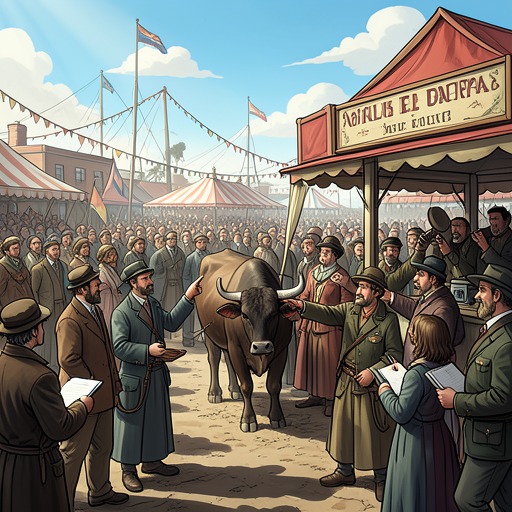
Francis Galton’s ox-weight experiment
The Wisdom of CrowdsFrancis Galton’s ox-weight experiment was an impromptu test of collective judgment conducted at a livestock fair in Plymouth in 1906. Galton, who expected ordinary people to judge poorly, gathered 787 legible estimates of an ox’s dressed weight and calculated their average. The crowd’s estimate missed the actual weight by just one pound, turning an attempt to measure the limits of popular judgment into a striking demonstration of its potential accuracy.
Setting and purpose
In the fall of 1906, eighty-five-year-old Galton left his home in Plymouth to visit the annual West of England Fat Stock and Poultry Exhibition. The fair brought farmers and townspeople together to assess cattle, sheep, chickens, horses, and pigs. For Galton, the displays connected two longstanding interests: measuring physical and mental traits, and breeding. He had devoted much of his career to arguing that only a small, select portion of the population possessed the qualities needed to sustain a healthy society.
That belief had informed his earlier work as well. At the 1884 International Exhibition in London, Galton established an Anthropometric Laboratory and used devices of his own design to test visitors’ sight, hearing, color sense, judgment of eye, and reaction time. The tests reinforced his low opinion of the public’s abilities. The ox competition offered an opportunity to assess judgment in a practical setting—and, potentially, to confirm his doubts about what an ordinary person could contribute.
The competition becomes an experiment
At the fair, a fat ox was displayed while members of the crowd wagered on how much it would weigh after slaughtering and dressing. For sixpence, each participant could buy a stamped, numbered ticket and enter a name, address, and estimate; prizes went to the most successful guesses. Eight hundred people took part. Some were butchers and farmers with relevant experience, while others had no particular knowledge of cattle.
Galton recognized that this mixed crowd resembled a democratic electorate: people with markedly different abilities and interests each supplied a judgment. He borrowed the tickets from the organizers after the competition and turned the entries into data. Thirteen estimates were illegible, leaving 787 for analysis. He arranged the usable guesses from highest to lowest, graphed their distribution to see whether it formed a bell curve, and calculated their mean. The average converted hundreds of separate estimates into a single figure: what the crowd would have guessed if it had been one person.
The result and its reversal
The group’s mean estimate for the dressed ox was 1,197 pounds. The animal’s actual dressed weight was 1,198 pounds. The one-pound difference made the collective estimate nearly exact, contrary to Galton’s expectation that combining a few capable judges with many mediocre ones would produce a poor answer.
Galton later described the result as more creditable to the reliability of democratic judgment than he had expected. The significance lay not merely in the accuracy of this particular estimate, but in the reversal it forced on the experiment’s premise. Galton had set out to examine the supposed deficiencies of the average voter; instead, his calculation suggested that a crowd containing both experts and nonexperts could make a sound judgment together.
From a fairground calculation to a general principle
The experiment became an opening illustration of a broader claim: under suitable conditions, groups can be remarkably intelligent and may outperform even their most capable members. Its mechanism was aggregation. Each participant supplied an estimate, and averaging those estimates allowed individual errors to offset one another while retaining information dispersed across the crowd. The result did not establish that every crowd or every collective decision would be wise; it showed that a group need not be dominated by exceptional experts to arrive at an accurate answer.
The book places Galton’s fairground calculation alongside very different cases, including the search for the lost submarine Scorpion and the market’s reaction to the Challenger disaster. In each, separate judgments or pieces of information could be combined into a larger assessment that no single contributor necessarily possessed. The ox and its numbered tickets thus provide a concrete model for collective intelligence: a crowd can hold, in aggregate, a more complete picture than its members hold individually.